
2025 is one of the years when Easter is the same Sunday for catholic/protestant with the Gregorian calendar and the orthodox with the Julian calendar.
Easter traditions in North Macedonia and Belgium are distinct, reflecting their respective cultural and religious backgrounds.
North Macedonia
- The week leading up to Easter, known as Holy Week, includes various religious services and rituals. Good Friday is a day of mourning, while Holy Saturday is marked by a midnight service where the resurrection of Christ is celebrated.
Traditions:
- Eggs: Red-dyed eggs, symbolizing the blood of Christ and rebirth, are a central part of the celebration. Families often dye eggs together and exchange them as gifts.
- Easter Bread: A special Easter bread called “pogacha” is baked and shared among family and friends.
- Feast: The Easter feast typically includes lamb, which is roasted on a spit, along with various traditional dishes like sarma (stuffed cabbage or vine leaves) and shopska salad.
- Children often participate in egg-cracking contests, where they tap their eggs against each other to see whose egg remains uncracked.
Belgium and Luxembourg
- Church services are held on Palm Sunday, Good Friday, and Easter Sunday. Many attend mass and participate in religious processions.
Traditions:
- Adults and children attend church services and family gatherings, where they enjoy a festive meal together.
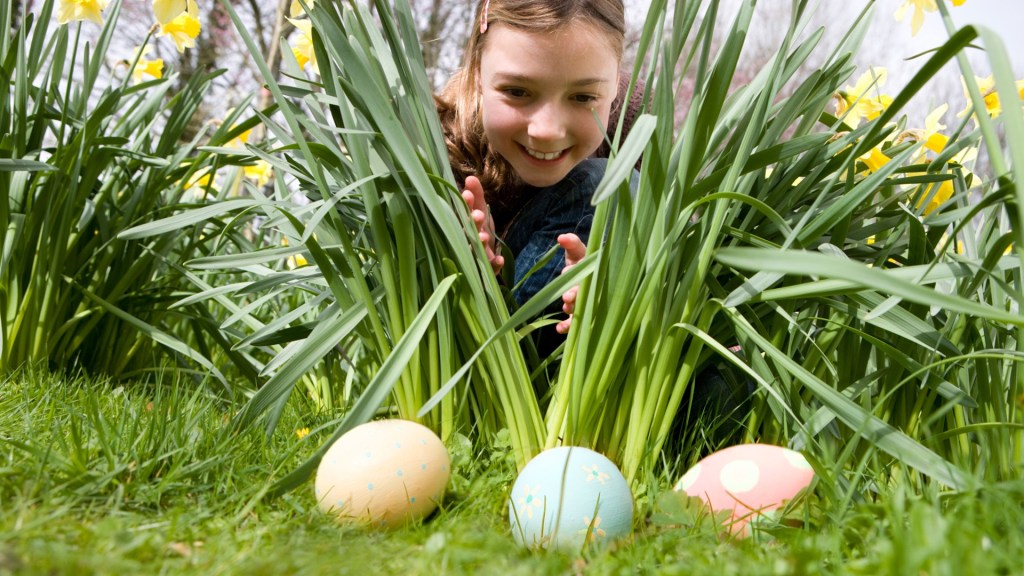
- Easter Eggs: Chocolate eggs and bunnies are popular gifts for children. Many families organize Easter egg hunts in their gardens or homes.
- Feast: The Easter meal often includes lamb, rabbit, or chicken, accompanied by seasonal vegetables like asparagus and potatoes. Desserts may include chocolate treats and traditional pastries.
- Easter Bells: In some regions, particularly in the French-speaking part of Belgium, it is believed that church bells fly to Rome on Maundy Thursday and return on Easter Sunday, bringing chocolate eggs with them. In Luxembourg, it is therefore up to the youngsters of the village to call the faithful to prayer with their Klibber (ratchet), a small wooden percussion instrument made with a toothed wheel that, when cranked, repeatedly strikes a flexible wooden strip. As it turns, they sing the Klibberlidd (ratchet song): “Dik-dik-dak, dik-dik-dak, haut as Ouschterdaag” (dik-dik-dak, dik-dik-dak, today is Easter).
- The custom of Jaudes (celebration of the Dog Rose) is a local tradition of Vianden, an Ardennes town in the north of the Grand Duchy of Luxembourg, celebrated on Good Friday. Jaudes refers to both the festival and to a bouquet of wild rose thorns, paper flowers, ribbons, etc. According to custom, after completing their bouquet, boys from Vianden go to their neighbourhood at noon and burn their Jaudes. This tradition, celebrated since the Middle Ages, is inspired by the Apostle Judas. Its purpose is to show the people’s disapproval of the apostle who betrayed Jesus and whose fate was to be condemned, symbolically, to hell.
- Women who received a pretzel on Bretzelsonndeg (Pretzel Sunday) are supposed to give an Easter egg in return on Easter Sunday as a sign of their love.
- On Easter Monday, the traditional Éimaischen (Feast of Emmaus) takes place. It is a popular folk festival celebrated in the old quarter of Luxembourg City and in the village of Nospelt.
The Éimaischen is primarily a traditional market where folk groups and all sorts of handicraft are waiting to be discovered. It is famously known for its Péckvillecher, terracotta birds which imitate the cuckoo’s calling when you blow into them. The origin of the Éimaischen as the potters’ market in Luxembourg City dates back to at least the 19th century. The Éimaischen recalls the march of Jesus Christ’s disciples to Emmaus, the Palestine village near Jerusalem where Christ appeared to two of them before his resurrection.
 Belgian-Macedonian Business Club
Leave a comment