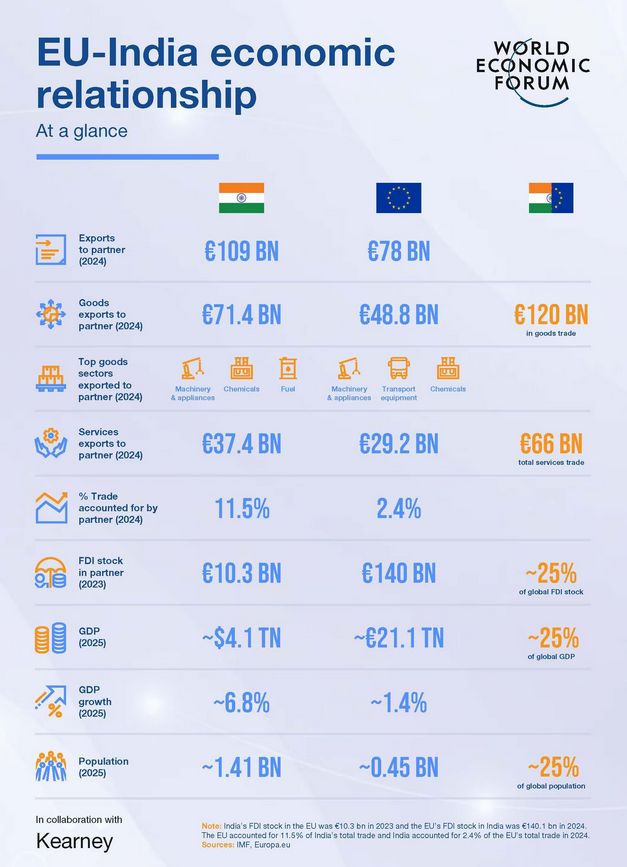
In January 2026, the European Union and India inked a Free Trade Agreement with India, linking two billion people and 25 % of global GDP. Indian Tariffs on 97 % of goods will be reduced or eliminated, the EU will reciprocate by reducing tariffs on 99,5 % of Indian goods. EU exports are expected to double by 2032.
EU and India trade 180 B€ of goods and services every year. India imported in total goods for 689 B$ in 2024 and Europe has not been an important supplier up to now. Germany, the largest European country, exported 17,7 B$ to India, followed by France with 6,7 B$, Italy with 5,8 B$ and Belgium with 4 B$. But it is the growth rate of imports that attracts the attention for the country with 1,4bill. inhabitants, the biggest population in the world.
Indian tariffs on cars are gradually going down from 110 % to as low as 10 %, while they will be fully abolished for car parts after five to ten years. Tariffs ranging up to 44 % on machinery, 22 % on chemicals and 11 % on pharmaceuticals will also be mostly eliminated. Indian tariffs on wines will be cut from 150 % to 75 % at entry into force and eventually to levels as low as 20 %, tariffs on olive oil will go down from 45 % to 0 % over five years, while processed agricultural products such as bread and confectionery will see tariffs of up to 50 % eliminated.
Beef, chicken meat, rice and sugar are excluded from liberalisation in the agreement. All Indian imports will continue to have to respect the EU’s strict health and food safety rules. A separate agreement on Geographical Indications (GIs) is in negotiation to remove unfair competition in the form of imitations.
This is the most ambitious trade opening that India has ever granted to a trade partner. It will give a significant competitive advantage for key EU industrial and agri-food sectors, granting companies privileged access to the world’s most populous country of 1.45 billion people and fastest growing large economy, with an annual GDP of €3.4 trillion.
EU commission
Both sides will put in place dedicated contact points to provide SMEs with relevant information on the FTA and help them with any specific issue they would face when trying to use the FTA’s provisions.
Indias largest import good with a 33 % share is energy, and precious metals with 12 % is the third largest group.
On the 462 B$ export side, the machinery group is first, notably cellular phone with 21 B$ which go to all continents. Refined petroleum is another large export hit, as are chemical products including pharmaceutics, diamonds and jewellery. Textiles, rice but also crustaceans stick out as well.
Concerning Belgium, the biggest import good of India are diamonds. But the 6,2 B$ in 2018 dipped to 1,8 B$ in 2023 and only slightly recovered in 2024 to 1,88 B$. Chemical products, machines and other goods needed for the industry are the largest part of the remaining 53 % of Indias imports from Belgium.
North Macedonia is a small supplier to India. In 2024, only 6,2 M$ of goods were exported to India, mainly industrial goods but also some chemical and mineral goods. Indian Telephones, Pharmaceuticals, textiles and other goods in the value of 97,6 mio € are imported to the country.
The BICCI Belgo-Indian Chamber of Commerce & Industry has about 2 000 contacts in Belgium who are involved in business with India. In 2025, they organised a mission to New Delhi and Mumbai, accompanied by HRH Princess Astrid, the Minister of Foreign Affairs, the Minister of Defense and the Minister-President of Flanders and supported by key members Proximus, John Cockerill, TCS Tata Consultancy Services, Port of Antwerp-Bruges and DEME group.
 Belgian-Macedonian Business Club
Leave a comment