
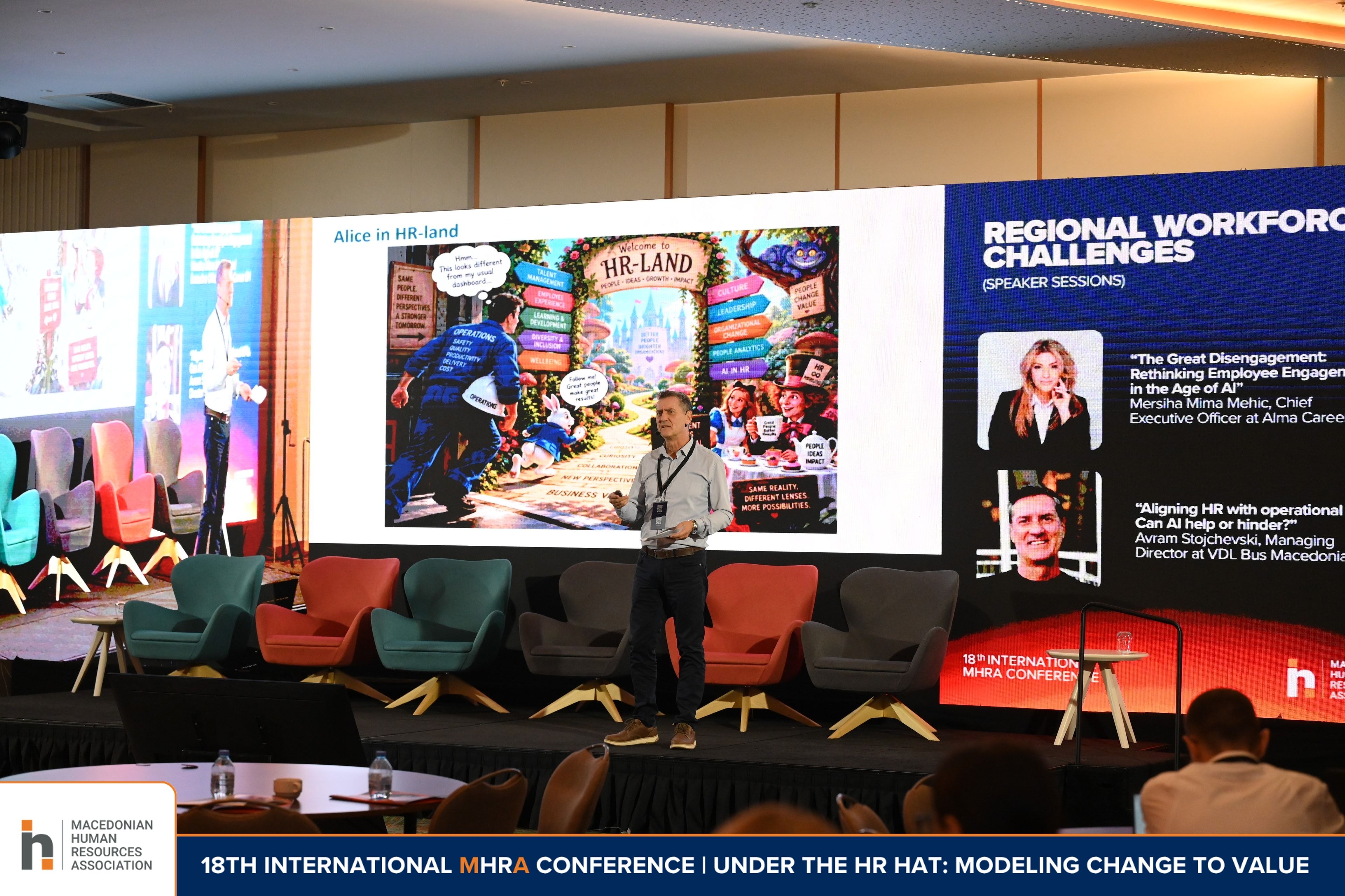
Strong business results are achieved when people, processes, and technology work in the same direction.
This correlation was at the heart of the presentation delivered by Avram Stojcevski, Managing Director of VDL Bus Macedonia, at the 18th Annual Conference, “Under the HR Hat: Modelling Change to Value,” organized by the Macedonian Human Resources Association. Stojcevski shared practical insights into aligning Human Resources (HR) with operational Key Performance Indicators (KPIs), as well as the role of Artificial Intelligence (AI) in modern business operations.
HR and Operations: Shared Goals, Shared Responsibility
In many organizations, HR and Production focus on different performance indicators.
HR monitors indicators such as employee turnover, time to hire, training hours, and talent retention. Operations, on the other hand, focuses on productivity, quality, production volume, efficiency, and costs. Although these indicators may appear different, they are closely interconnected.
Skills gaps can reduce productivity. Insufficient training can affect quality. High employee turnover can lead to a loss of experience, additional recruitment costs, and longer onboarding and training periods for new employees. Therefore, HR should not operate in isolation from operational processes, nor should Production assess results without considering the people responsible for achieving them.
When HR and Production align their objectives, Human Resources becomes part of the solution to operational challenges.
Productivity and Quality Start with People
One of the key manufacturing challenges highlighted by Stojcevski was maintaining stable productivity and quality in an environment of fluctuating demand, drawing on his experience of leading the company in Skopje for 14 years.
Stojcevski emphasized the importance of long-term workforce planning, continuous training, and retaining key employees. In his view, simply filling a vacancy is not enough. It is essential to recognize candidates’ potential, their attitude towards work, and their willingness to learn.
Leadership also plays a crucial role. An effective leader focuses not only on results but also on understanding the underlying causes behind them.
Artificial Intelligence as a Tool for Better Decision-Making
Artificial Intelligence undoubtedly opens up new opportunities for companies seeking to improve their processes and make data-driven decisions.
In HR, AI can support the analysis of job applications, the identification of potential candidates, and the forecasting of workforce needs. In operations, it can contribute to data analysis, forecasting specific needs, and identifying opportunities to improve efficiency.
However, Stojcevski emphasized that these opportunities also come with responsibility. AI results depend on the data used and on how systems are designed and implemented. If biases or inconsistencies exist in the data or algorithms, they can influence the outcomes. Therefore, automated analyses should never be accepted uncritically.
Human judgment, critical thinking, and an understanding of interpersonal relationships were highlighted as essential, particularly when making decisions that affect employees. AI should support people in their work, not eliminate accountability for making sound and fair decisions.

Working Together Towards a More Efficient and Sustainable Organization
One of the key messages from Avram Stojcevski’s presentation was that HR, Operations (Production), and Artificial Intelligence should function as interconnected elements of a unified system.
When these three elements work together, a company can better align workforce needs with production targets, direct resources towards the most important priorities, and use technology to support more efficient operations.
For VDL Bus Macedonia, this perspective highlights the importance of people, continuous improvement, and adapting to changes in the manufacturing industry. Technology can help us process more data, identify trends, and save time. However, its real value to the company lies in translating these insights into better decisions and tangible improvements.
AI can analyze the data, but people drive the company forward.
As Stojcevski concluded, sustainable success depends not only on technology or numbers but also on people’s ability to collaborate, learn, and work together to achieve the organization’s goals.
Leave a Reply